As of 2021, more than 5 million multilingual learners (MLLs) were enrolled in U.S. public schools: over 10% nationwide and around 20% in California and Texas. Federal guidance around MLL supports may be shifting, but the students—and their needs—are not.
Multilingual learners bring rich linguistic and cultural assets, yet too often they don’t get sufficient instructional support. A recent RAND survey found that about half of teachers serving MLLs feel underprepared, and 60% see a need for better MLL supports in their instructional materials.
EdReports MLL reviews provide educators and leaders with evidence to ensure every student has access to the high-quality materials they deserve.
These gaps highlight the urgency of ensuring that curriculum supports both content and language development. That’s why we’re proud to lead EdReports’ newly-expanded MLL reviews, providing educators and leaders with evidence to ensure every student has access to the high-quality materials they deserve.
Here are four key ways districts can use EdReports reviews to better serve MLLs:
1. Prioritize MLL needs from day one of curriculum adoption
Prioritizing multilingual learners in curriculum adoption starts with understanding why supports matter for these students. Too many educators are not given the training or resources they need to successfully integrate language development into instruction. RAND’s 2024 report Lost in Translation found that fewer than one-third of teachers reported having adequate materials to support MLLs, and few principals ranked MLL needs as a top priority—even in schools with large MLL populations.
Yet research shows the critical role of giving every learner access to grade-level content while integrating language development. Materials that overlook these supports risk reinforcing inequities and widening opportunity gaps.
Research shows the critical role of giving every learner access to grade-level content while integrating language development.
Before looking at any materials, adoption committees must begin with a deep understanding of local needs, data, and context. How many of your current students are MLLs and what languages do they speak at home? How might your student population evolve over the next 5-10 years? What do outcome data show for different groups? What professional learning do teachers need? Answering these questions up front positions committees to evaluate both the quality of MLL supports in potential materials and how well those supports align to real-world classroom needs.
2. Use EdReports’ dedicated MLL reviews
EdReports’ dedicated MLL reviews provide the first nationwide evidence on how instructional materials support both content and language development. With detailed, educator-led information, districts can bring new insight into adoption decisions and ensure alignment with their equity and excellence goals.
Our dedicated MLL reviews provide the first nationwide evidence on how instructional materials support both content and language development.
Because this work requires specialized expertise, we’ve developed dedicated tools, training, and processes to ensure deep and accurate evidence. First piloted in 2021 with California partners and refined through feedback from educators and districts, these tools reflect the realities of today’s classrooms.
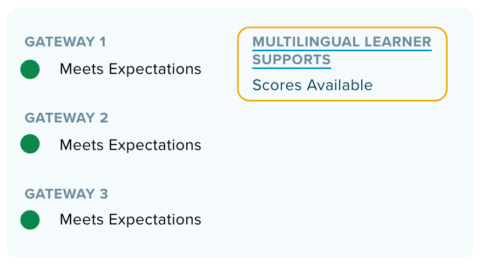
We published the first reports using dedicated MLL tools in summer 2025, with relevant v2.0 reports highlighted as having “Scores Available” for MLL Supports in our reports center.
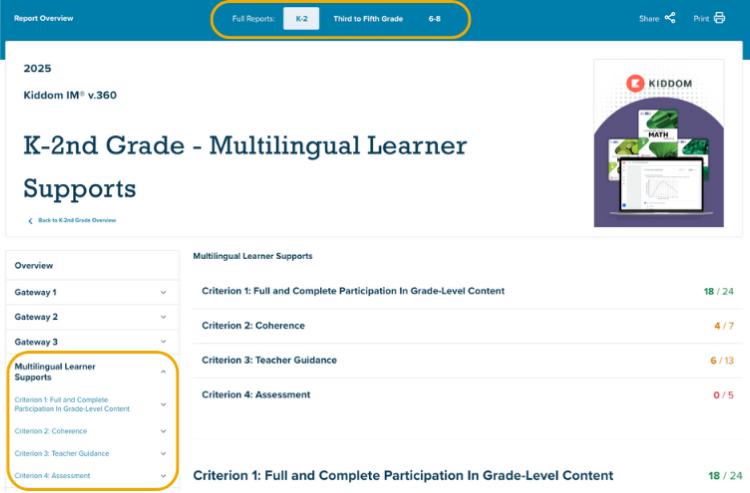
Each report offers two complementary lenses into the quality of a curriculum’s MLL supports. Within each grade band, the “Multilingual Learner Supports” section presents all MLL scores and evidence organized by four criteria: participation in grade-level content, coherence of supports, teacher guidance, and assessment.
Many MLL indicators, EdReports’ granular descriptors of quality, also appear in the core sections of the report (ELA, math, or science), alongside a corresponding, or “pair” core indicator.
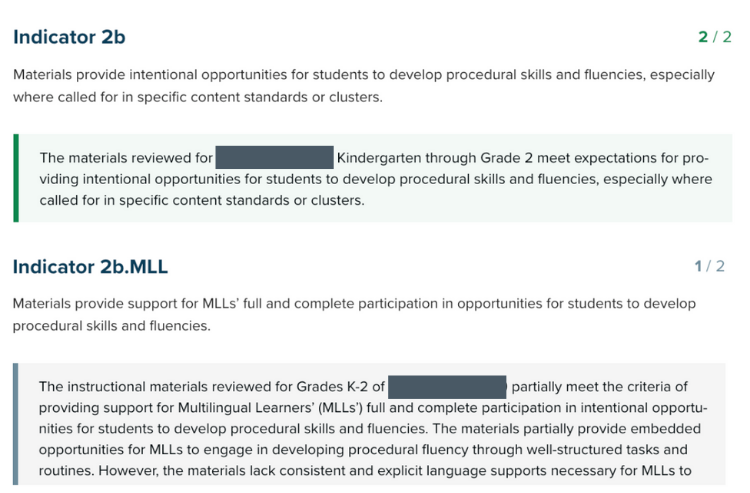
These pairings give educators and decision-makers clear, detailed information on how multilingual learners are supported in specific aspects of core content. This visibility is critical for making adoption decisions that reflect the integral role of MLL supports in curriculum quality.
3. Go beyond summary ratings
EdReports’ green, yellow, and red ratings offer a quick overview, but the real value of our reports comes from their detailed evidence. For v2.0 reports with MLL reviews, that’s especially true.
Currently, MLL scores in v2.0 reviews are reported independently from core content scores and don’t affect a program’s overall rating. The reason for this separation is that the field is still in a learning phase when it comes to identifying and delivering high-quality MLL supports. This approach allows us to provide clear evidence on both core content and MLL supports without conflating the two. As the field develops, we will continue to reassess our process to ensure that we are signaling the strongest possible indicators of quality.
Because MLL reviews require both content expertise and specialized knowledge, they’re more complex and time-intensive than core content reviews. To keep traditional ELA, math, and science reports flowing to the field, we publish them as soon as they are ready. In some cases, MLL evidence may be released on a different timeline, ensuring quality while getting information into educators’ hands quickly.
For districts, the takeaway is simple: don’t stop at the summary rating. Review the full report evidence, including for MLL supports.
While expanded MLL reviews were introduced with v2.0 reports, we’ve reviewed all K-12 comprehensive materials for MLL supports since 2020. For v1.5 reports, you can find MLL information in indicators 3q and 3s. And, for any materials that don’t yet have an expanded EdReports MLL review, you can use our latest MLL review tools to help you prioritize important aspects of MLL support in more detail as you evaluate programs.
For districts, the takeaway is simple: don’t stop at the summary rating. Review the full report evidence, including for MLL supports, to understand both strengths and areas for growth in materials.
4. Ask publishers for better MLL supports
When districts use MLL evidence in their adoption process, they send a powerful message: this matters. That feedback can drive publisher improvement and investment.
When reviewing a program that has an EdReports MLL review, adoption committee members can ask publishers what steps they’re taking to address the report’s findings. For materials without a dedicated MLL review, use EdReports MLL tools as a guide for questions such as:
- How do materials enable MLLs’ full participation in grade-level content?
- Are supports intentionally developed over time, reflecting the interdependence of language and content?
- Do materials provide teacher guidance to implement supports and assess MLLs’ understanding?
Prioritizing multilingual learners isn’t an afterthought—it’s central to providing equitable, high-quality education.
Giving every student the chance to thrive
Prioritizing multilingual learners isn’t an afterthought—it’s central to providing equitable, high-quality education. By deeply understanding local needs, using detailed evidence from EdReports’ MLL reviews, and pressing publishers to strengthen supports, districts can help raise the bar for quality and give every student the chance to thrive.